

The Downhill Tax: Why Descents Destroy Strong Hikers and How to Train for It
Downhills are where strong hikers get humbled. This post breaks down the downhill tax, eccentric loading, & how to protect your knees and quads before the trail teaches you the hard way.
If you read Post 1 of this series, you already know the elephant in the room: gym fitness is not the same thing as trail readiness. Today we’re diving deep into the first skill block we touched on in The 5 Physical Demands of Hiking, and it’s the one most people discover too late: sustained eccentric loading.
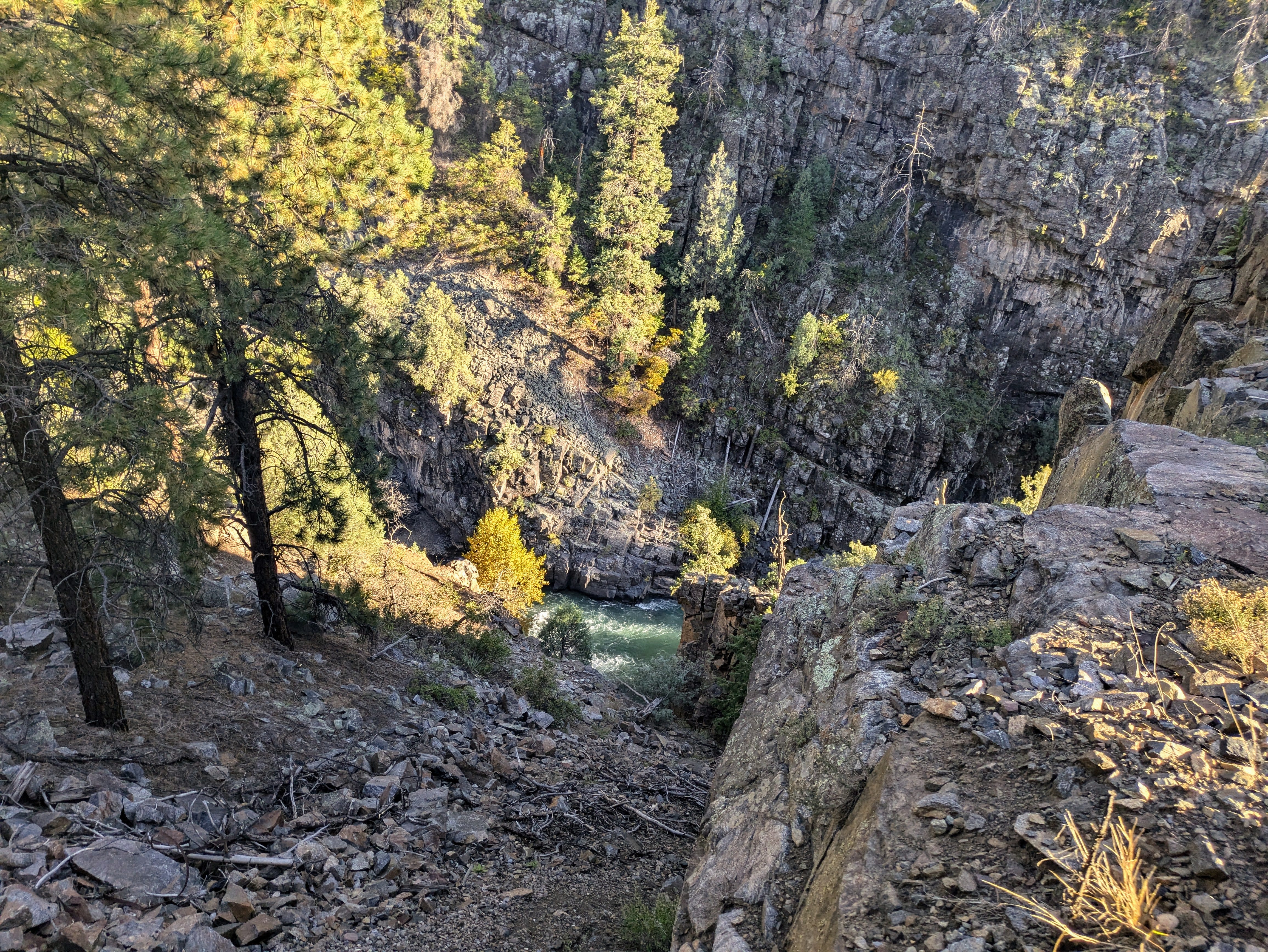
Downhill is where hikers learn humility.
The annoying part is that downhills often feel fine in the moment. You’re moving as if your body’s on autopilot, crushing the miles ahead. Perhaps you are even feeling a little smug, preemptively celebrating your hard-won victory over the summit you’ve just completed.
The next morning, your body barks back, and it doesn’t stop for the next hundred miles. This kind of pain accumulates gradually, keeping you restless, constantly searching for the right position at night because your pain is competing directly with your sleep and recovery.
Ironically, the biggest descent of the entire Colorado Trail is tucked into the final segment. Segment 28 drops 6,557 feet into Durango, the terminus of the trail. On paper, it is the kind of day that should make your quads quiver and quake with fear. Looking back, we were all a little intimidated by this last leg of our 500-mile journey.
In reality, though, it was pretty chill.
Goldfinch and I both said the same thing about that last day: the final miles went fast. He texted me that morning stating he was moving like a freight train, and ended up finishing the trail only minutes after I did. My journal line from that day reads like an overdose of caffeine and metaphor (per usual):
The last 11 miles go so fast. Storming the gates of Durango sooner than expected. Two Colorado Trail fighter pilots on a runway to the sky…
I assure you it is not because downhills are “easy”, or because Goldfinch and I are extra strong (though we like to think so).
It’s because, by that point, our bodies had adapted to the chaos. Simply put:
Downhill does not care how strong you are. It cares whether you are adapted to braking your body under load, thousands of times, for hours.
Most backpacking training plan advice never says it that plainly. It will tell you to do more cardio, strengthen your legs, maybe hike more. Sometimes it will even tell you to get trekking poles, like they are an insurance policy you can buy at REI.
Poles help; I will get to that. But the real fix is more boring and more honest: you need to train the braking.
The pain point: what is actually happening on downhills
When you descend, your quads, calves, and hip stabilizers do a specific kind of work called eccentric contraction. That means the muscle is lengthening while it is producing force.
You are not pushing yourself up. You are resisting gravity while it tries to pull you down.
Every step is a controlled micro-fall.
This is why downhills feel easy on your lungs, but brutal on your legs. You are not redlining your cardiovascular system; you are paying a mechanical bill with your tissues.
Sports medicine literature is consistent here: unaccustomed eccentric work is a major driver of exercise-induced muscle damage and delayed onset muscle soreness; the symptoms are not just soreness, but temporary reductions in strength and altered mechanics.
If you have ever wondered why you can feel fine on a downhill and then feel fragile later, this is one reason. Your capacity to produce force can drop after eccentric-heavy work, which is a fancy way of saying your legs can be weaker tomorrow even if you feel tough today.
On trail, that has real consequences: if you are weaker tomorrow, you are also sloppier tomorrow. And sloppy on uneven terrain is how people turn a long hike into a logistics problem.
What generic training misses and why
Most gym training is designed around concentric strength and predictable patterns. Even when you lift heavy, you are doing it in controlled conditions. Flat floor, stable platforms, known load and duration. The movement ends when you decide it ends.
The trail is the opposite. It is long, uneven, and variable. It continues even after your form starts negotiating.
Downhill is where the mismatch becomes obvious. You can squat. You can deadlift. You can crush a stair climber session. Then a long descent shows up and your quads feel like they have never met you before.
I’m a NASM-certified trainer, and one of the simplest ways to identify eccentric work is also one of the least flattering: eccentric contractions tend to produce more post-exercise soreness than other muscle actions, especially when the stimulus is new.
The trail is extremely good at delivering a stimulus that is new.
It is also extremely good at repeating it the next day.
This is why hikers can look strong and still get wrecked on descents: the gym builds capability while the trail demands durability.
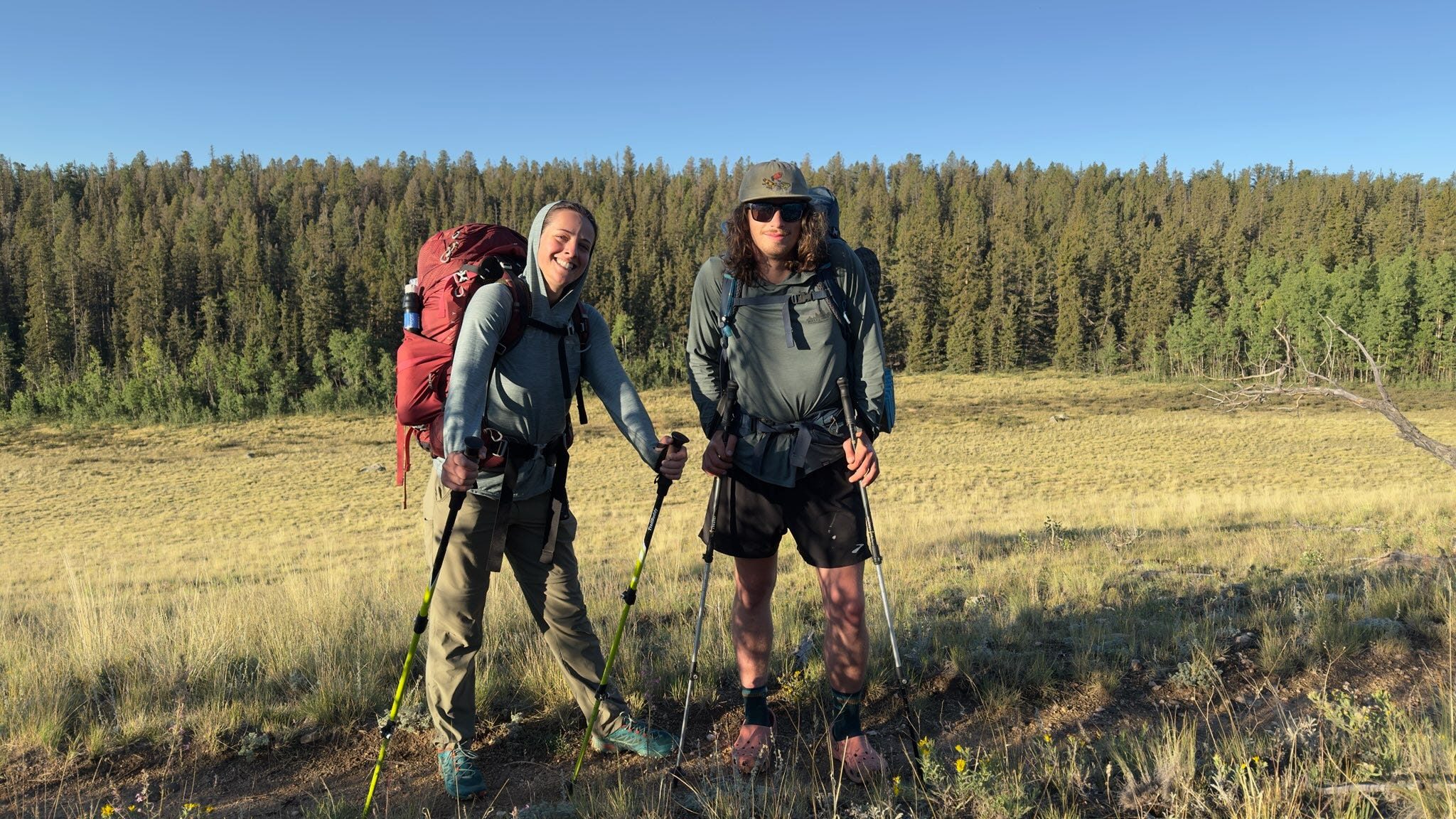
Why this matters most for thru-hikers
Here is the counterpoint I hear often, and I get why it exists:
“Downhill is easier than uphill. I can always just go slower. Plus, pain is normal on trail.”
Yes, you can go slower. You should go slower, especially early on.
But going slower does not erase eccentric loading. It just spreads the work out across more time. Also: pain being normal does not mean dysfunction should be acceptable.
There is a difference between 1) expected discomfort and 2) a breakdown in mechanics that increases injury potential. The first is a given for long trails like the Colorado Trail, the Continental Divide Trail, and the Pacific Crest Trail. The second is how people end up taking surprise rest weeks in towns (while simultaneously butchering their intended trail budget).
The truth I need you to hear
If you have not trained your legs to brake under load, the mountain will train them for you. The tuition is paid in knees, quads, budget leaks, and timeline adjustments.
I’m not saying this to scare you; I’m saying it because pretending otherwise is how people get blindsided.
When the downhill bill arrived for me
My first real audit on the Colorado Trail was not some dramatic San Juans descent or the big finish into Durango. It was early, foreboding, and a bit rude.
I started the CT on the 12th of August. By the morning of the 14th, in Segment 3, after about 5,500 feet of cumulative ascent and less than 3,000 feet of descent, my quads and knees were already showing massive fatigue.
Not injury, not collapse. Fatigue. The kind that makes you realize you are spending mental energy just to keep your movement clean.
I pushed into Bailey just before Segment 4 and took an unexpected nero at Two Bridges Lodge. If you are ever in that area, I highly recommend it: high-tech hostel vibe with sauna/cold plunge, showers, laundry, kitchen access, basically everything a hiker could ask for. I camped by the river instead of taking a bunk and still had access to all their lovely amenities.
My journal from that nero makes it clear the main fatigue was mental. But, as most seasoned hikers know, mental and physical fatigue share a bank account. That is what beginners tend to miss: if you are mentally cooked, your foot placement changes. If your foot placement changes, your stability changes. If your stability changes on a descent with a full pack, your day can go sideways quickly.
Taking a nero early was strategic, not weak. And it worked.
Load makes the downhill tax worse
My base weight on the CT was 16.5 pounds. With consumables, my total carry at full resupply was closer to 34 pounds. That extra weight mattered, not just for effort, but for how I moved.
With a full pack, I was slower and more methodical because I had to be. With a pack that was about ten pounds lighter, usually when heading into town with most food and water consumed, the same terrain felt like a straight shot.

Weather adds a multiplier too. Descents that are fine in dry conditions get dicey when it rains. I remember hiking in a downpour one day with Uno Reverse, and the sordid state we were in as we came up onto Tennessee Pass Trailhead. We looked like mud-covered banshees and had a hard time getting a hitch into town. That day included a few descent oopsies that were not catastrophic, but they were instructive.
Loose scree, steep rocky step-downs, and snow were the most difficult conditions for me. Wet slabs and rooty forest were more manageable in the right shoes; I wore La Sportiva Bushido III trail runners.
None of that changes the physics. It just changes how much margin you have when you make a mistake.
What actually prevents blown knees & quads
Two things:
progressive eccentric exposure
movement discipline when fatigue shows up
The research supports the first in a straightforward way. Repeated exposure to eccentric work tends to reduce the damage and soreness response from later bouts. This is called the repeated bout effect.
In plain English: your body adapts to what you make it do, especially when you introduce the stress gradually rather than all at once.
There is also evidence in the downhill running literature that downhill-specific training can improve certain performance and muscular outcomes, which fits what hikers observe in the real world: practice the descent, and you get less wrecked by it.
Does hiking downhill equal downhill running?
No. Different impact profiles, different pacing, different footing. But the eccentric demand is a shared feature; it is still the braking problem.
The downhill training protocol excerpt
This is not a full plan. It’s a small excerpt, the kind of thing you could layer into an existing routine without detonating it.
A. Eccentric strength (2x per week)
Step-downs from a box; slow lower, light touch, stand tall
Split squat or lunge with a slow lowering phase
Decline treadmill walking or controlled downhill hikes, short and gradual at first
B. Descent skill (1x per week)
Practice small steps, knees slightly bent, quiet feet
Practice not leaning back; keep your center of mass over your feet
Use poles deliberately, not as decorations
C. Tissue tolerance and recovery (ongoing)
Don’t stack huge downhill days back-to-back early
Fuel before climbs and before long descents
Take micro breaks before you are sloppy
Trekking poles are optional until they aren’t
I use trekking poles on descents, and they do their job well. They are extra contact points designed to help with balance, and they distribute some load away from the knees and ankles.
REI’s guidance is practical and simple: adjust poles properly, and consider lengthening them slightly for long downhills to help maintain posture and balance.
But poles do not replace coordination; they simply support it. My ability to save myself on descents was not just poles. It was also training for balance, stability, and reaction time, so when fatigue hit, I had a pattern to fall back on.
If you are early in a long trail, do not bomb your descents. By the end, you might feel coordinated enough to fly downhill. In the beginning, bombing is how people bench themselves for two weeks mid-trail.
Self-audit: is this your blind spot?
A few questions. Answer them honestly.
Do your knees lock when you get tired on descents?
Do your heels start slapping the ground harder than you intend?
Do you lean back and then wonder why your footing gets worse?
Do you speed up because you want it to be over, even though you feel sloppy?
Have you ever finished a trail day feeling fine, then woken up weaker and stiffer than expected?
Have you ever felt plantar fasciitis symptoms flare?
I had a flirtation with plantar fasciitis in my right foot during the first week of the CT. Potentially catastrophic if ignored. I addressed it immediately: kinesiology tape, strain reduction, and being smarter about load and pacing. On long trails, you deal with problems when they are small. You do not wait for them to compound into a trip-ending issue.
If several of these questions hit, downhill is a skill block you need to train.
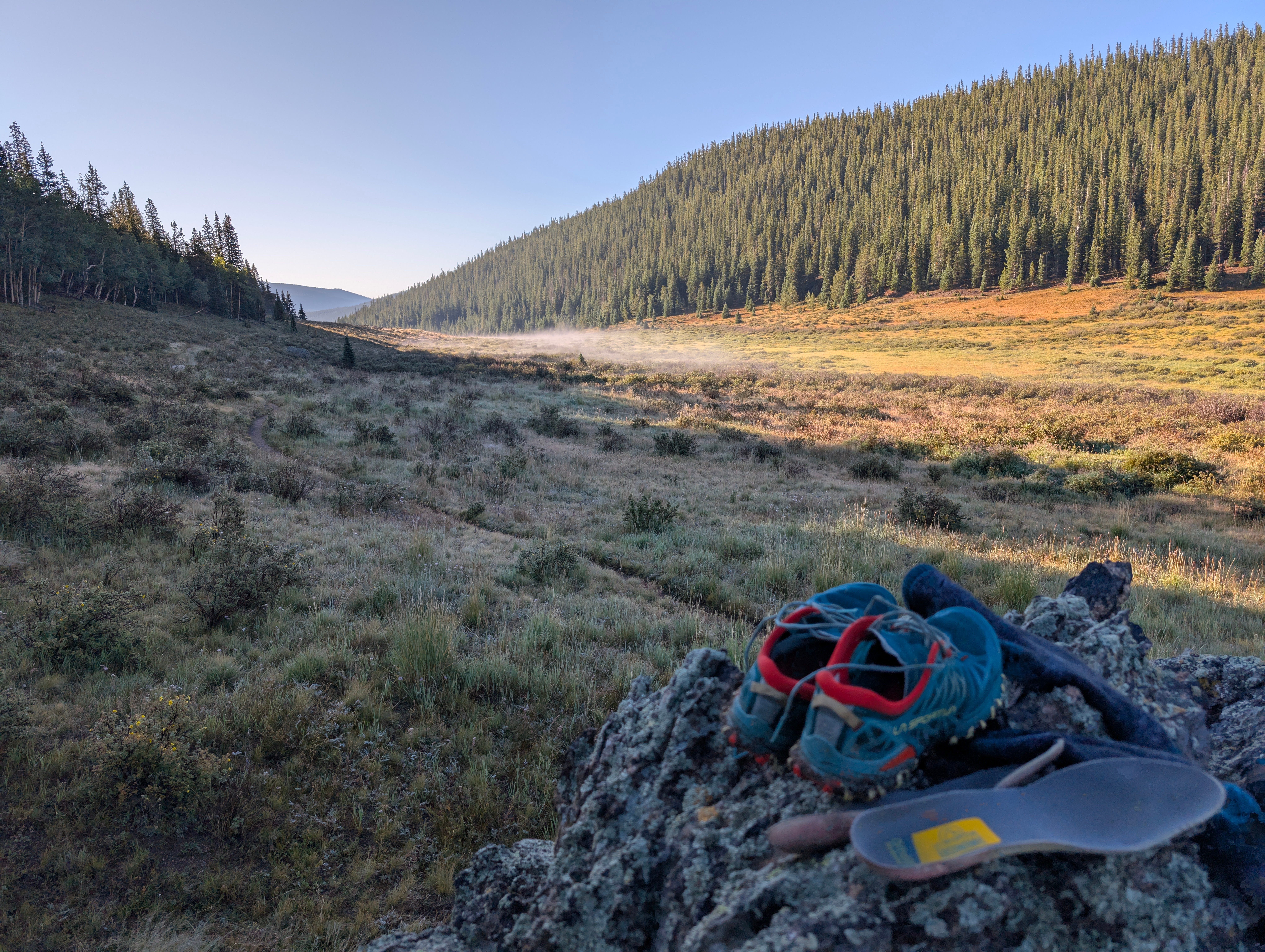
Where the trail goes from here
Downhill strength is demand one. It is the loudest one, because your quads will make sure you hear about it.
But it is not the only one.
In the next post, we move to the demand that decides whether downhill fatigue stays uncomfortable or becomes dangerous: reaction time, balance, and stability on uneven terrain. When fatigue slows your corrections, the trail gets sharp.
And if you’ve had a downhill moment that humbled you, or a strategy that saved your knees, leave a comment below. This series gets better when hikers share their personal stories on what helped (and what didn’t) prepare them for the long trail ahead.
You can find me elsewhere (Tiktok, Instagram) at @freda.heights. If you’d like to support the TTF journey, you can do so here. If you are planning on hiking the Colorado Trail this year, click the discount button below to claim our limited-time offer and receive full access to exclusive CT downloadables, guides, & resources.
Until next time, happy trails!
— Freda
I am glad I stumbled upon your writing! This was so informative and gave me a lot to think about, and add into my training routine!
Would love to hear more about your treatment of plantar fasciitis on the trail! Thanks for the articles.